
By Carol Peters September 9, 2026
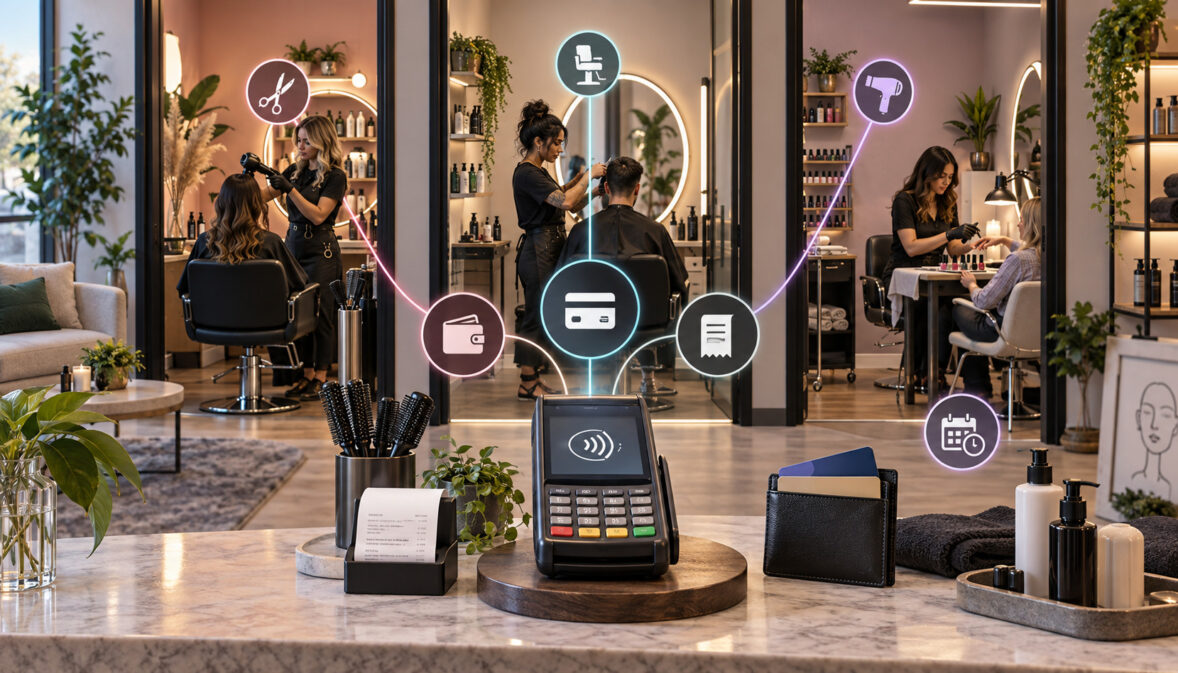
A salon can have one reception desk, one booking calendar, and even one physical checkout device without every stylist necessarily being the same merchant. That distinction is the foundation of a compliant booth renter credit card processing setup.
Multiple independent stylists or booth renters may be able to use the same front-desk checkout hardware when the payment platform is intentionally designed to route each transaction to the correct business or approved submerchant account.
The bigger problem arises when a salon owner uses one ordinary salon merchant account to process sales that actually belong to several legally separate independent businesses.
The physical machine is only an access point. Behind it are the payment account or merchant ID, the merchant of record, the settlement account, transaction descriptor, refund responsibility, dispute exposure, and tax-reporting trail.
For a true independent renter, a cleaner operational chain usually looks like this:
Customer books renter → renter performs service → payment processes under renter’s payment relationship → funds settle to renter → renter accounts for fees, refunds, tips, disputes, and taxes → renter pays booth rent separately.
Centralized processing can make sense under a different business model—for example, where the salon itself sells the service and stylists are employees or commission-based providers. Worker classification, however, depends on the entire relationship and applicable law, not merely who runs the card.
The objective is therefore not to ask, “How many machines do we need?” Start with a better sequence:
Identify provider business status → identify merchant of record → determine correct MID/payment account → configure checkout → route settlement → allocate refunds and chargebacks → reconcile taxes and provider income.
Can Two Independent Businesses Share One Credit Card Machine?
The question can two businesses share one card terminal actually contains two separate questions.
First: can two people physically use the same device?
Potentially, yes. Payment software may support multiple provider profiles, multiple merchant configurations, or an approved payment-facilitator structure. A receptionist might use the same screen and card reader for several providers while software determines which payment account receives each transaction.
Second: can two independent businesses simply run their transactions through one business’s ordinary merchant account?
That is materially different.
If stylist A operates an independent business and stylist B operates another independent business, putting both businesses’ sales onto the salon owner’s MID can create a mismatch between the business that actually supplied the service and the merchant relationship that submitted the transaction.
Visa’s rules formally distinguish ordinary merchants from sponsored merchants and payment facilitators. The current Visa Core Rules and Visa Product and Service Rules explain how merchant, acquirer, payment-facilitator, and sponsored-merchant relationships are structured, including the agreements and responsibilities that apply when one platform supports multiple underlying merchants.
Visa’s current public rules distinguish merchants and sponsored merchants partly by which entity sells the goods or services, identifies itself to the cardholder, and provides recourse in a dispute. Visa also considers factors such as which entity books the sale as revenue, handles returns, and provides customer service when determining the relevant payment role.
Mastercard’s rules separately recognize payment-facilitator and submerchant arrangements rather than treating third-party processing as something any ordinary merchant account can perform informally.
Mastercard documentation has also used “transaction laundering,” “factoring,” and “transaction aggregation” in connection with transactions processed for another merchant or submerchant where the acquirer or payment facilitator lacks the appropriate merchant or submerchant agreement.
That is why the safest question is not “Whose hands touched the terminal?” It is:
Which business was actually accepting the customer’s payment?
Shared Hardware vs. Shared Merchant Account
| Setup | Physical Device Shared? | MID Shared? | Key Risk |
| Each renter uses their own reader | No | No | More devices and logins |
| Shared front desk with correctly routed merchant profiles | Yes | No or provider-specific | Requires supported software configuration |
| Approved PayFac/submerchant architecture | Possibly | Platform-managed | Must be an actual approved payment structure |
| Owner’s ordinary MID processes independent renters’ sales | Yes | Yes | Merchant identity, underwriting, 1099-K, reconciliation, and chargeback problems |
| Central salon sells all services | Yes | Yes | Can fit when salon is genuinely merchant of record |
A shared credit card machine for multiple businesses is therefore not automatically a problem. The configuration behind the machine matters.
Why the Merchant Account Matters More Than the Physical Terminal

A payment terminal and a merchant account serve different purposes.
The terminal is the hardware through which the customer inserts, taps, or otherwise presents a card. If you need to compare hardware types first, this guide on how to select the best credit card machine for your business explains the main device categories and connectivity choices.
The payment account or MID relationship identifies the merchant for processing purposes. Processor terminology differs, and some platforms aggregate merchants under broader account structures rather than giving each business a traditional standalone MID. The critical point is that the payment provider still needs to know which business it is enabling to accept payments.
The settlement account is where the transaction proceeds ultimately go.
The merchant of record is the business presented as responsible for the sale. Depending on the payment architecture, that determination involves more than the statement descriptor alone.
Important facts include who sold the service, who contracted with the customer, whose name appears during checkout, who receives the revenue, who handles refunds, and who answers the customer’s dispute.
Consider a client booking a $180 color appointment with an independent stylist.
If the stylist determines the price, provides the service as their own business, owns the customer relationship, receives the economic benefit of the sale, and is expected to handle refunds, it would be unusual operationally for an unrelated salon merchant account to appear in the middle merely because the salon owns the reception desk.
The cleaner payment architecture is generally:
Stylist’s service → stylist’s merchant/payment profile → stylist’s settlement → stylist’s ledger.
If the salon is choosing fixed checkout hardware, it is also worth reviewing how to select the best payment terminal for your business before assuming a device will support multiple merchant profiles.
What Booth Renter Credit Card Processing Should Look Like

For genuinely independent providers, booth renter credit card processing works best when payment ownership follows business ownership.
Suppose a stylist leases a station, operates under their own business identity, books their own clients, establishes their service pricing, and receives their own service revenue. A typical payment flow would be:
- Customer books the stylist.
- Booking is assigned to that provider.
- Stylist performs the service.
- Checkout identifies the stylist’s business.
- Customer payment runs through the stylist’s merchant or approved payment account.
- Processor settles funds to the stylist’s designated bank account.
- Processor fees, refunds, tips, and disputes remain traceable to that provider.
- Stylist records the sale in their books.
- Stylist pays agreed booth rent to the salon through a separate rent-payment process.
This structure makes the sales ledger, processor statement, deposit record, and underlying customer transaction tell the same story.
That becomes especially valuable at month-end.
Instead of a salon bookkeeper receiving one $32,000 settlement report and trying to determine which portion belongs to six independent businesses, each renter can reconcile:
Provider sale → provider payment account → processor settlement → provider bank deposit.
The salon’s own books then show rental revenue separately.
This does not mean separate physical terminals are always necessary. A properly configured platform may preserve provider-specific merchant identities while allowing common checkout hardware.
Why Processing a Booth Renter’s Sales on the Salon MID Creates Risk

Processors and acquiring banks do not underwrite a card-acceptance relationship solely by looking at a terminal model.
Their approval is based on information about the merchant and its activity, which may include legal identity, ownership, business type, products or services, processing methods, anticipated volume, transaction characteristics, settlement information, and risk profile.
Now consider this arrangement:
- The salon owner applies for processing as a hair salon.
- Three booth renters later operate separate businesses.
- Each renter sells services to their own customers.
- Every card transaction is processed on the salon owner’s ordinary MID.
- The owner receives all deposits and transfers money to renters afterward.
The processor may now be receiving activity that differs from the merchant arrangement it originally understood.
That does not mean every multi-provider salon arrangement is prohibited. A salon can legitimately be the merchant selling services in some business models. Approved marketplaces, payment facilitators, platforms, and multi-merchant configurations can also support multiple underlying businesses.
The risk arises when an ordinary merchant account is effectively being used to accept transactions for separate businesses without an approved structure.
Factoring, Aggregation, and Merchant-of-Record Issues
Payment-industry terminology deserves care because different providers do not always use identical labels.
Mastercard maintains formal requirements governing merchants, acquirers, payment facilitators, and submerchants. Its current Mastercard Rules and compliance programs are the appropriate primary reference for determining how these relationships are expected to be structured and when processing activity may fall outside an approved merchant arrangement.
Mastercard documentation describes transaction laundering as including activity where a merchant or submerchant processes transactions on behalf of another merchant or submerchant that does not have the appropriate agreement with the acquirer or payment facilitator. The Mastercard material also associates transaction laundering with factoring or transaction aggregation.
Visa approaches approved aggregation through formal structures such as payment facilitators and sponsored merchants. Visa’s payment-facilitator framework requires payment facilitators to contract with the acquirer and sponsored merchants and to operate under the network’s rules.
Those architectures should not be confused with a salon owner deciding independently to function as an informal aggregator.
The core concern is:
One merchant account is accepting payment for goods or services actually supplied by another independent business, even though the acquiring relationship was not approved for that role.
Potential consequences depend on the processor, acquirer, agreement, transaction history, and underlying facts. They may include:
- underwriting review,
- requests for contracts or supporting records,
- funding holds or reserves,
- account restrictions,
- suspension,
- requirement to restructure processing,
- or termination.
Termination is not automatic, and the response differs by provider.
Avoid trying to “fix” the problem by changing transaction descriptions, miscoding businesses, or concealing who provided the service. The appropriate solution is to disclose the actual operating model to the processor and use an approved structure.
Why Processors Care Who Actually Made the Sale
Imagine an acquirer approves a business because it expects one salon company to sell haircut, coloring, and styling services.
Months later, the same MID is processing payments belonging to:
- an independent hairstylist,
- a separate nail business,
- an esthetician,
- a massage practitioner,
- and the salon owner.
These businesses may have different ownership, prices, customers, refund policies, dispute histories, and underlying services.
The merchant identity matters because card acceptance creates obligations beyond transmitting payment data.
For a transaction, somebody must be responsible when:
- the customer claims the service was never provided,
- a refund was promised but not issued,
- the descriptor is unrecognized,
- a recurring payment is challenged,
- fraud is alleged,
- documentation is requested,
- or a chargeback is filed.
The account structure tells the processor which merchant it expects to answer those questions.
That is also why the merchant descriptor deserves attention. A client who books “Alexis Hair Studio” but later sees an unrelated salon company on the statement may have difficulty recognizing the transaction.
Descriptors alone do not determine merchant status, but they should accurately support the customer-facing payment relationship.
Merchant of Record Should Anchor the Salon Suite Payment Setup
A workable salon suite payment setup starts with a merchant-of-record decision for each category of service.
Ask:
- Who sells the service?
- Who determines what the customer owes?
- Whose business name does the customer see?
- Who receives the economic revenue?
- Who owes the customer a refund?
- Who responds if the customer disputes the transaction?
- Who maintains the service record?
Those questions usually reveal whether the salon or the individual provider belongs at the center of the payment transaction.
For a true renter operating a separate business, the renter will often be the natural merchant.
For an employee/commission model, the salon may be the natural merchant because the customer is purchasing the salon’s service and the provider receives compensation from the salon.
The payment flow should follow that commercial reality rather than forcing every salon into the same architecture.
The 1099-K and Accounting Problems With One Shared MID
The tax-reporting problem with one shared MID is not hypothetical. The IRS specifically addresses shared credit-card terminals.
Current IRS guidance says that when someone shares a credit-card terminal with another person or business, the Form 1099-K may include that other party’s payment-card transactions as well as the account holder’s payments.
The IRS tells taxpayers in such situations to maintain appropriate records and, where required, furnish the appropriate information returns to the parties whose payments were included.
This can become a significant bookkeeping issue for salons.
Assume the salon owner’s merchant account processes:
| Business | Card Sales |
| Salon owner’s own services | $100,000 |
| Renter A services | $60,000 |
| Renter B services | $50,000 |
| Total processed through salon MID | $210,000 |
The payment settlement reporting associated with that account can reflect the account’s gross payment activity rather than neatly presenting only the salon owner’s economic share.
The owner must then reconcile why processor reporting exceeds the sales the owner considers economically theirs.
This issue is especially important because payment-card transactions do not use the same federal reporting threshold as third-party settlement organization transactions. The IRS states that direct payment-card transactions can generate Form 1099-K reporting regardless of the dollar amount or number of transactions.
For third-party settlement organizations, current federal rules generally use the restored threshold of more than $20,000 and more than 200 transactions, although forms can still be issued below that threshold and state rules may differ.
A 1099-K Reports Gross Payment Activity, Not Automatically Taxable Profit
Receiving a Form 1099-K for $210,000 does not automatically mean the salon has $210,000 of taxable profit.
IRS instructions define the gross amount without reductions for items such as fees, refunds, credits, discounts, or other adjustments. IRS taxpayer guidance likewise stresses that an amount appearing on Form 1099-K is not automatically taxable income and must be reconciled using the taxpayer’s books and records.
That distinction does not make the shared-MID arrangement desirable.
It means the salon may now need considerably more documentation to explain the relationship between:
- gross card volume,
- salon revenue,
- renter-owned revenue,
- transfers to renters,
- processor fees,
- refunds,
- tips,
- and any other amounts.
The correct tax treatment depends on the actual business relationships and facts. A CPA, enrolled agent, or other qualified tax professional should review the salon’s particular reporting structure.
Booth Rent vs. Commission Accounting
A booth-rental model and a commission model are economically different arrangements.
In a commission model, the salon may sell the service to the customer, collect the revenue, and compensate a provider through wages or another properly structured compensation arrangement.
In a booth-rental model, an independent provider may earn revenue from their own customers and separately owe rent for workspace or services supplied by the salon.
Running both models through one undifferentiated payment stream can make the books look like something different from the underlying commercial arrangement.
This article does not determine whether a provider is legally an employee or independent contractor. Worker classification depends on the entire relationship and applicable federal and state law, not one payment characteristic.
Employee vs. Booth Renter Payment Structure
| Business Model | Merchant of Record | Settlement Destination | Main Consideration |
| Salon employee | Often salon | Salon | Salon generally sells service and compensates employee |
| Commission-based salon provider | Often salon, depending on structure | Salon | Customer relationship and compensation model matter |
| Independent booth renter | Usually renter/business | Renter | Separate settlement generally aligns better with independent business revenue |
| Approved submerchant model | Under configured PayFac architecture | As platform structure provides | Providers must be correctly onboarded |
| Mixed salon | Varies by transaction/provider | Varies | Checkout must select correct merchant relationship |
Option 1: Give Each Booth Renter Their Own Merchant Account
For genuinely independent beauty professionals, a separate booth renter merchant account or equivalent individual payment account is often the cleanest structure.
The provider applies using their own accurate business information and establishes the settlement relationship tied to their business.
The exact arrangement depends on the provider. A sole proprietor, LLC, corporation, or other business structure may have different onboarding documentation. The payment company determines what information it needs.
Once approved:
- transactions are attributed to the renter,
- settlements go to the renter’s account,
- the renter sees their own processor reporting,
- refunds remain tied to their transactions,
- disputes reach the appropriate payment relationship,
- and the renter’s sales can be reconciled independently.
That creates much clearer financial boundaries.
Booth Renter Merchant Account Setup Steps
A practical implementation sequence is:
- Establish the correct business identity: The renter should use accurate legal and business information.
- Select the appropriate settlement account: Use the account appropriate for the business and provider requirements.
- Apply with the payment provider: Accurately describe the services, processing channels, and anticipated activity.
- Configure the payment method: This might be a reader, terminal, supported phone acceptance method, or provider profile in salon software.
- Configure receipts and descriptor information: The customer’s payment record should make the transaction recognizable.
- Process a controlled test transaction.
- Test the refund workflow.
- Verify settlement: Confirm that the deposit reaches the intended renter account.
- Verify provider reporting.
- Retain monthly records.
Do not stop after a test card authorization. The full test is:
sale → tip, if applicable → settlement → bank deposit → refund → reporting.
Low-Volume Readers and Mobile Payment Options
An independent stylist processing modest volume may not need a full countertop station.
Potential options include:
- a mobile card reader,
- smartphone-based acceptance,
- Tap to Pay functionality when supported by the provider and device,
- a compact countertop terminal,
- or a provider-specific payment link for appropriate transactions.
For providers who move between chairs, suites, or off-site appointments, a guide to mobile payment acceptance can help explain how portable card acceptance differs from fixed countertop checkout.
Separate readers have an obvious advantage: settlement ownership is difficult to confuse when every renter operates their own account and device.
They also create drawbacks:
- several devices at reception,
- several chargers,
- separate credentials,
- separate receipt workflows,
- and a less unified checkout experience.
Those inconveniences are why multi-merchant software can be valuable—but only when the software truly supports the required merchant architecture.
Individual Renter Payment Options
| Option | Setup Complexity | Cost Model | Best Fit |
| Mobile reader | Low to moderate | Often transaction-based; provider terms vary | Low-volume independent renter |
| Tap to Pay | Low to moderate | Provider-specific | Mobile independent provider |
| Compact countertop terminal | Moderate | Hardware plus processing structure varies | Renter with fixed suite |
| Provider-specific payment link | Low to moderate | Provider-specific | Deposits or remote payments where suitable |
| Shared multi-merchant checkout | Higher | Platform-specific | Salon wanting unified reception without shared settlement |
No universal fee structure applies. Providers may use flat-rate pricing, percentage-plus-transaction pricing, monthly fees, equipment costs, or other models.
Option 2: Central Salon Processing
Central processing can be entirely rational when the salon itself is the business selling the service.
Imagine a salon where:
- clients book with the salon,
- salon management controls the service menu,
- the salon establishes customer pricing,
- receipts identify the salon,
- customer revenue belongs to the salon,
- the salon handles refunds,
- and providers receive wages or commission under their compensation arrangements.
In that model, routing transactions through the salon merchant account is operationally coherent because the salon is functioning as the merchant.
The fact that one stylist physically performs the haircut does not require every employee to have a separate merchant account.
When Employees and Commission Providers Fit This Model
Payment architecture is much easier when provider compensation and customer revenue are clearly different concepts.
Suppose the customer pays the salon $150.
The salon records $150 as customer revenue. Under its employment or compensation arrangement, the salon then calculates what it owes the provider.
Those are separate accounting events:
Customer → salon payment
followed by:
Salon → provider compensation
A merchant account is designed to capture the first transaction. Payroll or another legitimate compensation process handles the second.
Central reception, centralized refunds, shared terminals, and salon-level reporting can all make operational sense under this model.
Why True Renters Are Different
Now change the facts.
The stylist:
- operates a separate business,
- rents a station,
- maintains their own clientele,
- determines their own service prices,
- bears their own business expenses,
- considers customer service revenue their own business income,
- and pays rent to the salon.
If the salon nevertheless collects every card payment onto the salon MID and later redistributes the money, the payment flow is no longer naturally aligned with the stated booth-rental model.
This does not by itself determine tax or employment classification, and some properly approved platform structures can legitimately collect and distribute funds.
But an ordinary salon merchant account should not be assumed to provide that functionality merely because the owner can calculate payouts in a spreadsheet afterward.
How Salon Suite Payment Setup Can Use Shared Front-Desk Hardware
A unified customer experience does not require a unified merchant account.
A sophisticated salon suite payment setup could operate like this:
Booking belongs to provider → receptionist opens appointment → system identifies provider’s business → correct merchant profile is selected → customer taps card on common device → transaction is submitted under correct payment configuration → funds settle according to that configuration → transaction remains attached to provider’s ledger.
From the customer’s perspective, checkout takes place at one desk.
Behind the counter, however, the software preserves the distinction between businesses.
The key is that provider routing happens as part of an approved payment architecture—not by manually moving money after every transaction.
Provider-Specific MIDs
Some payment ecosystems can support more than one merchant relationship in an integrated environment.
That may involve:
- multiple MIDs,
- provider-specific merchant profiles,
- multiple payment accounts,
- or another processor-approved method.
Support depends on the POS software, payment processor, terminal, gateway, and underlying acquiring setup.
Do not assume a terminal advertising multiple employees, departments, locations, or users also supports multiple legal merchants.
“Employee profile” and “merchant profile” solve different problems.
One controls who operates the software.
The other controls which business accepts the transaction.
Payment Facilitator/Submerchant Routing
Payment facilitators are an important alternative because they explain how a platform can support many small businesses without pretending all of those businesses are one merchant.
Visa describes this model in its official Payment Facilitator Model. Under that structure, a payment facilitator works through an acquiring relationship and contracts with sponsored merchants, allowing multiple underlying businesses to be onboarded and supported without treating their transactions as if they all belonged to one ordinary merchant account.
A payment facilitator can contract with an acquirer and onboard sponsored merchants or submerchants under an approved structure. That is materially different from an ordinary salon owner informally aggregating card sales.
A legitimate PayFac/submerchant model has:
- an acquiring relationship,
- seller onboarding,
- merchant or submerchant agreements,
- identification of underlying businesses,
- transaction monitoring,
- settlement rules,
- and network obligations.
For a deeper explanation of this broader payment model, see what a payment service provider is and how it works.
Shared Front-Desk Checkout Without Shared Revenue
A receptionist can process a payment without becoming the merchant.
Imagine six independent salon suites sharing a reception desk.
At checkout, the receptionist:
- Opens the customer’s appointment.
- Confirms which provider performed the service.
- Confirms the amount and tip.
- Lets the system select the provider’s configured payment account.
- Presents the common payment device.
- Sends or prints the receipt.
- Closes the appointment.
The employee operating the terminal may work for the salon, while the payment belongs to an independent provider.
That workflow can be practical if—and only if—the processor and software intentionally support it.
The system should preserve these identifiers:
- provider,
- merchant/payment profile,
- customer,
- booking,
- transaction ID,
- gross amount,
- tip,
- processor fee where available,
- settlement,
- refund,
- and chargeback.
Without those relationships, “shared checkout” can quickly turn into shared accounting confusion.
Who Pays the Chargeback?
Chargebacks expose one of the biggest operational weaknesses of informal shared-MID arrangements.
The processor works through the merchant relationship that submitted the transaction. As a practical matter, the account through which the disputed transaction was processed is typically the account against which the processor administers the dispute and resulting debit, subject to the provider’s agreement and procedures.
Suppose renter A performs a $250 color service, but the charge runs through the salon owner’s merchant account.
Three weeks later, the customer disputes the transaction.
The salon may now face this sequence:
Customer dispute → salon MID → processor dispute notice → salon merchant account debit or adjustment → salon must obtain evidence from renter A.
The renter may have:
- appointment records,
- consultation notes,
- messages,
- service photos where appropriate and lawfully retained,
- and details about the customer’s complaint.
The salon owns the merchant relationship, but the renter owns much of the evidence.
That gap causes delays and confusion.
For merchants that need more background on what happens after a customer challenges a card payment, how banks investigate disputes provides useful context on the dispute process.
Chargeback Responsibility
| Transaction Setup | Processor Debits/Handles Through | Evidence Owner | Operational Problem |
| Renter processes own transaction | Renter payment relationship | Renter | Responsibilities align |
| Salon sells service | Salon payment relationship | Salon/provider records | Normal centralized workflow |
| Independent renter sale on salon MID | Salon payment relationship | Often renter | Merchant and evidence owner differ |
| Approved submerchant setup | According to platform structure | Provider/platform | Platform rules govern allocation |
A salon agreement can require a renter to reimburse certain disputed amounts, subject to applicable law and enforceability.
But that contractual obligation is separate from what the processor does.
If the processor debits the salon’s merchant account, a booth-rental contract does not cause the network dispute automatically to move onto the renter’s merchant account.
What Evidence Should Be Preserved?
Useful service records may include:
- appointment booking,
- service date,
- provider identity,
- description of services performed,
- transaction receipt,
- customer communications,
- check-in or completion records,
- applicable refund or cancellation terms,
- customer acknowledgement where appropriate,
- evidence that an agreed refund was processed,
- and other documentation relevant to the dispute reason.
Evidence requirements depend on the dispute and processor instructions.
How Refunds, Tips, and Deposits Should Be Routed
Provider separation should continue after the original sale.
Refunds
A refund should generally be processed through the payment relationship associated with the original transaction.
That preserves the chain:
Original transaction → transaction ID → refund → merchant statement → settlement adjustment.
Sending money through an unrelated method because the wrong merchant account handled the sale does not repair the underlying reconciliation problem and may create new accounting complications.
Each salon should also determine whether refund policies are provider-specific or centralized.
If independent providers establish their own policies, the customer-facing experience should identify which business is responsible.
Tips
Tips add another field that must remain attributable to the correct provider.
A useful transaction record should identify:
- service amount,
- provider,
- tip amount,
- total card charge,
- payment account,
- and settlement destination.
Employment, payroll, and tax treatment of tips depends on the facts and applicable law. The payment system should not make those determinations; it should produce reliable data for the business and its payroll or accounting processes.
Booking Deposits
A booking deposit should follow the same merchant-of-record logic as the eventual service.
If an independent stylist sells the appointment, the salon should not casually place every booking deposit onto the salon owner’s ordinary merchant account simply because its booking page happens to be centralized.
A properly designed platform may be able to route the deposit to the provider’s merchant/submerchant relationship.
Gift Cards
Shared gift cards create additional complexity because somebody must carry the obligation to provide future services.
Before allowing a gift card purchased from one business to be redeemed with unrelated renters, determine:
- who sold the gift card,
- who carries the outstanding liability,
- who funds redemption,
- whether participating providers have agreed to the arrangement,
- and how the payment system reconciles redemption.
Packages and Memberships
Packages create similar questions.
If the salon sells a $500 package and several independent renters may perform the included services, the salon needs a structure explaining who is actually obligated to the customer and how providers are compensated.
Calling a relationship “booth rental” does not answer those payment questions.
Reconciliation: Keep Provider Revenue and Booth Rent Distinct
For an independent renter, the cleanest reconciliation chain is:
Provider sale → provider MID/payment account → processor settlement → provider bank deposit.
Separately:
Renter → salon → booth rent payment.
This makes it possible to prove why money moved.
The salon can collect booth rent using an appropriate method such as:
- ACH,
- recurring invoice,
- authorized card payment,
- check,
- or another agreed method.
If the salon uses automatic deductions from provider proceeds, that should occur through a payment architecture designed and approved for split settlement or platform payouts.
Do not assume that manually retaining a portion of every renter’s customer sales is equivalent to an approved split-payout structure.
Shared MID Tax and Reconciliation Problems
| Problem | Why It Happens | Better Structure |
| 1099-K includes renter transactions | All card sales flow through account holder’s payment relationship | Provider-specific payment accounts or properly structured platform |
| Salon deposits exceed salon sales | Renter revenue enters salon bank account | Direct provider settlement |
| Renter cannot match sales to deposits | Owner redistributes net amounts | Provider-level settlement reporting |
| Processor fees are difficult to allocate | Fees are assessed on combined activity | Provider-specific fee reporting |
| Refund responsibility is unclear | Original sale sits under salon MID | Refund through correct provider transaction |
| Tips become difficult to reconcile | Provider attribution is separated from settlement | Track tip at transaction/provider level |
| Chargebacks reach wrong business | Salon MID processed renter sale | Align transaction with responsible merchant |
What the Booth Rental Agreement Should Say About Payments
A booth-rental agreement should not stop at monthly rent and access hours.
The payment section should explain how booth renter credit card processing works operationally.
At minimum, counsel drafting or reviewing the agreement should consider addressing:
- whether renters provide their own merchant/payment account,
- whether shared checkout equipment is available,
- whether the platform uses individual merchant or submerchant profiles,
- where customer funds settle,
- who pays processing costs,
- how tips are allocated,
- who issues refunds,
- who maintains supporting transaction records,
- who responds to disputes,
- who ultimately bears losses under the parties’ agreement,
- whether authorized amounts can be deducted through the platform,
- what happens to open disputes after termination,
- and how access is disabled when the renter leaves.
These are business points first. The final contract language should be reviewed under applicable state law.
Merchant-of-Record Clause
One of the most valuable provisions is clarity around which business sells the service.
For example, the agreement should make the intended structure unambiguous as to:
- whose service the client is purchasing,
- which merchant/payment account should accept that transaction,
- and which business is responsible for customer refunds.
A contract label alone does not control worker classification or override payment-network rules, but documenting the intended commercial relationship can help prevent contradictory operations.
Processing Fees
Possible arrangements include:
- renter pays their processor directly,
- platform deducts its authorized fees before settlement,
- salon charges an agreed technology or administration fee where properly structured,
- or another disclosed arrangement.
There is no universal appropriate fee model.
The agreement and actual payment configuration should tell the same story.
Chargebacks
A payment section should address:
- who monitors dispute notices,
- how quickly the renter must provide evidence,
- what documentation must be retained,
- who bears the contractual loss,
- whether reimbursement can be collected,
- and what happens when a dispute arrives after the renter leaves.
Contractual reimbursement does not change which merchant account the processor initially associates with the transaction.
Refund Policy
Determine whether:
- every independent renter maintains their own policy,
- participating businesses adopt standardized policies,
- or some hybrid structure applies.
Whatever model is selected, the receipt, booking process, customer communication, and merchant identity should not contradict each other.
Booth Rental Agreement Payment Terms
| Clause Area | What to Clarify | Why It Matters |
| Merchant of record | Which business sells the service | Establishes payment ownership |
| Merchant account | Which account processes customer payment | Prevents accidental aggregation |
| Settlement | Where proceeds are deposited | Supports reconciliation |
| Processing fees | Who bears them | Prevents renter disputes |
| Tips | How provider attribution works | Preserves transaction detail |
| Refunds | Who approves/issues them | Keeps customer policy aligned |
| Chargebacks | Evidence and loss allocation | Establishes post-dispute duties |
| Rent deductions | Whether and how permitted | Avoids informal withholding |
| Offboarding | Records, refunds, disputes, account access | Protects both parties after termination |
Ending the Booth Rental Relationship
Offboarding needs a payment checklist just as onboarding does.
When a renter leaves:
- Disable their access to salon systems.
- Remove them from future booking availability.
- Disable checkout access without deleting historical records.
- Preserve prior transaction IDs.
- Preserve settlement and refund records.
- Identify unresolved chargebacks.
- Determine how future refunds will be handled.
- Stop booth-rent billing at the appropriate time.
- Remove the provider’s payment profile from new transactions.
- Preserve records for applicable accounting, tax, contractual, and dispute-retention requirements.
Do not delete transaction records simply to clean up the provider list.
Historical payments may still generate refunds, retrieval requests, disputes, accounting questions, or tax reconciliation needs.
PCI DSS and Shared Checkout
Multi-provider payment architecture does not eliminate payment-security obligations.
PCI DSS v4.0.1 remains the current PCI Data Security Standard.
The salon should use processor-supported hardware and software rather than attempting to modify terminal configurations informally.
Provider selection should happen through approved application functionality.
Do not:
- write card numbers into provider notes,
- share stored card credentials between unrelated businesses,
- manually reconfigure sensitive payment credentials at checkout,
- or build unofficial workarounds around processor controls.
A multi-merchant system should reduce administrative confusion, not create new handling of cardholder data.
How to Fix an Existing Shared-MID Setup
Many salons discover this issue only after years of sending every payment through one terminal.
Do not panic, and do not try to conceal the historical arrangement.
Map the operation first.
1. Identify Who Is Actually Independent
List every provider.
Separate:
- employees,
- commission providers,
- independent renters,
- business entities,
- and any unusual hybrid relationships.
If worker classification itself is uncertain, seek appropriate tax or employment counsel rather than using the payment system to decide it.
2. Map Transactions by Provider
For a representative period, identify:
- service sales,
- tips,
- deposits,
- refunds,
- disputes,
- processing fees,
- and payouts.
The goal is to understand who economically owns each stream.
3. Review the Existing Processor Agreement
Determine which legal entity owns the existing merchant relationship and what business activity was disclosed.
4. Tell the Processor How the Salon Actually Operates
Ask whether the arrangement is approved.
Describe the businesses accurately.
Do not change merchant descriptors or classifications as a substitute for processor approval.
5. Select the Future Architecture
Potential solutions include:
- individual renter merchant/payment accounts,
- provider-specific payment profiles,
- approved multiple-MID functionality,
- an approved PayFac/submerchant platform,
- or separate mobile readers.
6. Configure Provider Routing
Each independent provider should be mapped to the payment account intended for their transactions.
7. Test Full Settlement
For each provider, test:
sale → tip → settlement → bank deposit → refund.
Verify that the transaction does not merely appear under the correct stylist in the POS report while still settling to the wrong merchant account.
8. Verify Descriptors and Receipts
The customer’s records should accurately identify the merchant relationship.
9. Update Booth-Rental Agreements
Make payment responsibilities consistent with the new workflow.
10. Establish a Cutover Date
Avoid an undefined transition where some transactions use the old structure and others use the new one without documentation.
11. Reconcile Historical Shared-MID Activity
Preserve the prior reports.
Historical allocation should be reviewed with the salon’s tax professional because payment-settlement reporting can include activity belonging economically to more than one party when a terminal or payment account has been shared.
12. Move Future Transactions to the Correct Accounts
Once testing is complete, use the approved architecture consistently.
Common Booth Renter Credit Card Processing Mistakes
The most common mistakes happen because physical checkout feels simpler than the financial architecture behind it.
Common Mistakes Table
| Mistake | Risk | Better Approach |
| Assuming one terminal means one legal merchant | Confuses hardware with merchant identity | Determine merchant of record first |
| Processing every independent renter on owner’s MID | Potential underwriting and aggregation concerns | Separate accounts or approved platform |
| Splitting deposits manually afterward | Settlement trail does not match customer transactions | Route correctly before settlement |
| Ignoring Form 1099-K impact | Gross reporting may include other businesses | Reconcile provider-level payments |
| No provider-level ledger | Refunds and deposits become difficult to trace | Store provider with every transaction |
| Salon automatically absorbs renter disputes | Wrong party bears operational loss | Define dispute responsibility |
| One unclear refund policy | Customer responsibility becomes uncertain | Align policy with merchant structure |
| Buying terminals before verifying multi-MID support | Hardware may not support architecture | Approve processing design first |
| No payment terms in rental agreement | Fees and disputes become contentious | Document roles |
| Treating commission providers and renters identically | Commercial models become blurred | Map payment model to actual relationship |
Practical Booth Renter Payment Setup Workflow
A salon opening new suites—or repairing an existing structure—can use this sequence.
Step 1: Identify Each Provider’s Business Status
Determine the actual relationship based on the applicable facts and professional guidance.
Do not rely solely on what the contract calls the provider.
Step 2: Determine Merchant of Record for Each Service
Identify which business is selling each service to the customer.
Step 3: Separate Central Salon Providers From Independent Renters
This prevents one configuration from being imposed on fundamentally different business models.
Step 4: Review the Existing Processor Agreement
Determine what activities the provider approved.
Step 5: Choose the Payment Architecture
Use:
- separate merchant/payment accounts,
- supported multiple-MID functionality,
- or an approved submerchant/PayFac structure as appropriate.
Step 6: Configure Provider-Specific Routing
Every appointment should map to the correct payment profile.
Step 7: Connect the Correct Settlement Account
Verify where the processor actually sends money.
Step 8: Test Sales
Run controlled provider-specific tests.
Step 9: Test Tips
Verify provider attribution.
Step 10: Test Refunds
Confirm the refund is attached to the original transaction.
Step 11: Verify Descriptors
Make sure the customer can recognize the business.
Step 12: Configure Front-Desk Selection
Train receptionists to confirm provider before presenting the card device.
Step 13: Track Provider-Level Transactions
Keep booking ID, provider, merchant profile, transaction ID, amount, and tip together.
Step 14: Reconcile Settlements Separately
Compare each provider’s sale totals against processor settlements and deposits.
Step 15: Collect Booth Rent Separately
Use a defined rent-payment workflow unless an approved payout system legitimately supports deductions.
Step 16: Define Processing-Fee Responsibility
Document who bears each applicable fee category.
Step 17: Define Refund Responsibility
Do not wait for the first angry customer.
Step 18: Define Chargeback Responsibility
Specify evidence obligations and contractual loss allocation.
Step 19: Verify Tax Reporting With an Accountant
Ensure processor reports, provider ledgers, and tax reporting can be reconciled.
Step 20: Repeat the Review When Providers Join or Leave
Payment architecture is part of onboarding and offboarding.
Booth Renter Payment Setup Checklist
- Identify employee, commission-provider, and independent-renter relationships.
- Determine merchant of record for each service.
- Review the processor agreement.
- Do not run unrelated independent-business sales through an ordinary salon MID without approval.
- Choose separate merchant accounts or an approved multi-merchant/submerchant structure.
- Connect each provider to the correct settlement account.
- Configure provider-specific checkout routing.
- Verify customer-facing descriptors.
- Test sale, refund, and tip workflows.
- Confirm provider-level deposits.
- Track provider-level settlements.
- Track provider-level chargebacks.
- Keep booth rent separate from customer service revenue unless a properly structured payout arrangement applies.
- Reconcile Form 1099-K reporting with the accounting records.
- Review tax reporting with a qualified tax professional.
- Define payment acceptance in the booth-rental agreement.
- Define processing-fee responsibility.
- Define refund responsibility.
- Define chargeback responsibility.
- Preserve historical transaction records when renters leave.
- Review payment routing whenever a provider joins, leaves, or changes business structure.
Frequently Asked Questions
Can two booth renters share one credit card machine?
Potentially, yes, if “share” means using common physical checkout hardware. The payment system should still route each transaction to the correct merchant or approved submerchant account when the renters are independent businesses.
Can independent stylists process payments through the salon owner’s merchant account?
Do not assume they can. Processing transactions belonging to separate independent businesses through an ordinary salon MID can conflict with the payment structure that the processor or acquirer approved. Ask the processor to review the actual arrangement.
What is factoring in credit card processing?
Payment terminology varies, but network and acquiring documentation may use factoring, transaction aggregation, or transaction laundering when one merchant processes transactions belonging to another merchant without the appropriate acquiring or payment-facilitator relationship.
Is a shared terminal the same as a shared merchant account?
No. A terminal is hardware. The merchant/payment relationship determines which merchant processes the sale. One physical device may sometimes support transactions belonging to different merchant profiles when the platform and processor are designed for that configuration.
Does every booth renter need a separate merchant account?
Not necessarily a traditional standalone MID. An independent renter might instead operate as an appropriately onboarded sponsored merchant or submerchant through an approved platform. The key is that the payment arrangement recognizes the renter’s business rather than silently placing unrelated sales on another merchant’s ordinary account.
Can a salon receptionist take payment for an independent renter?
Yes, operationally that can be possible. The receptionist can operate shared checkout hardware while software routes the transaction to the independent provider’s configured merchant/payment account. The person pressing the checkout buttons does not have to be the merchant.
Can one POS system route payments to different stylists?
Some systems can, but support must be confirmed. A POS that can report sales by employee does not necessarily support multiple merchants, MIDs, settlement accounts, or submerchant relationships.
What is a multi-MID salon setup?
A multi-MID configuration generally means a payment environment that can associate transactions with different merchant identifiers or merchant relationships. Exact terminology and implementation vary by processor and platform.
How does Form 1099-K work if all renter sales go through the salon account?
A shared credit-card terminal or payment account can cause processor reporting to include payment activity belonging economically to other people or businesses. That makes accurate provider-level records and tax reconciliation especially important.
Who reports the income from booth renter card sales?
Tax reporting depends on the actual business relationship and applicable tax rules. A Form 1099-K is an information return showing gross payment activity; it does not by itself determine taxable profit or which economic arrangement the parties actually have. An accountant should reconcile processor reports with each business’s books.
Who pays a chargeback when a renter’s customer disputes?
The processor administers the dispute through the payment relationship that processed the transaction. If an independent renter’s transaction ran on the salon’s MID, the salon’s merchant relationship may receive the dispute even though the renter holds the customer and service records.
Can the salon deduct booth rent from renter card sales?
An approved platform may support split settlement, deductions, or payout arrangements. That is different from informally withholding independent renter proceeds from transactions processed on an ordinary salon merchant account. Confirm the structure with the processor and accountant.
Should tips settle directly to the booth renter?
The payment system should at minimum preserve provider-level tip attribution. Where and how tips ultimately settle depends on the underlying business and employment relationship, tax rules, applicable wage laws, and payment architecture.
What should a booth-rental agreement say about credit-card payments?
It should address merchant of record, merchant/payment accounts, settlement, fees, refunds, tips, chargebacks, evidence responsibilities, approved deductions, and what happens to outstanding transactions when the renter leaves.
Conclusion
The central question in booth renter credit card processing is not whether two stylists can physically touch the same card machine. It is which merchant relationship actually accepts each customer’s transaction.
True independent renters generally benefit from having payment settlement aligned with their own businesses, whether through separate merchant/payment accounts or a properly approved multi-merchant, sponsored-merchant, or submerchant structure.
When the salon itself genuinely sells the service and providers are compensated under an employee or commission model, centralized salon processing can make operational sense.
Problems arise when those models are blurred. Sending independent renter sales through the salon owner’s ordinary MID can create underwriting questions, inflate or complicate the owner’s Form 1099-K reconciliation, separate chargeback liability from the provider who holds the evidence, and make refunds, tips, deposits, and bookkeeping harder to trace.
A unified front desk does not require mixed revenue. Properly configured software can let reception staff select the provider, run one familiar checkout workflow, and route the transaction to the appropriate payment relationship.
Start with the merchant of record, not the machine. Once that decision is correct, hardware, settlement, accounting, refunds, and disputes become much easier to organize.