
By Carol Peters September 10, 2026
Picture this. A customer swipes their card at your checkout counter. Nothing looks unusual. But hidden inside the card reader is a tiny skimming device, quietly copying every card number that passes through. By the time anyone notices, dozens of customers have already been affected. This scenario plays out at businesses across the United States every year, and it is almost always preventable. The fix is simple and often ignored: a daily payment terminal tamper inspection log.
This guide covers what a payment terminal tamper inspection log is, why it matters, what US payment card rules expect, and how to build a log that actually protects your terminals instead of sitting in a drawer.
What Is a Payment Terminal Tamper Inspection Log?
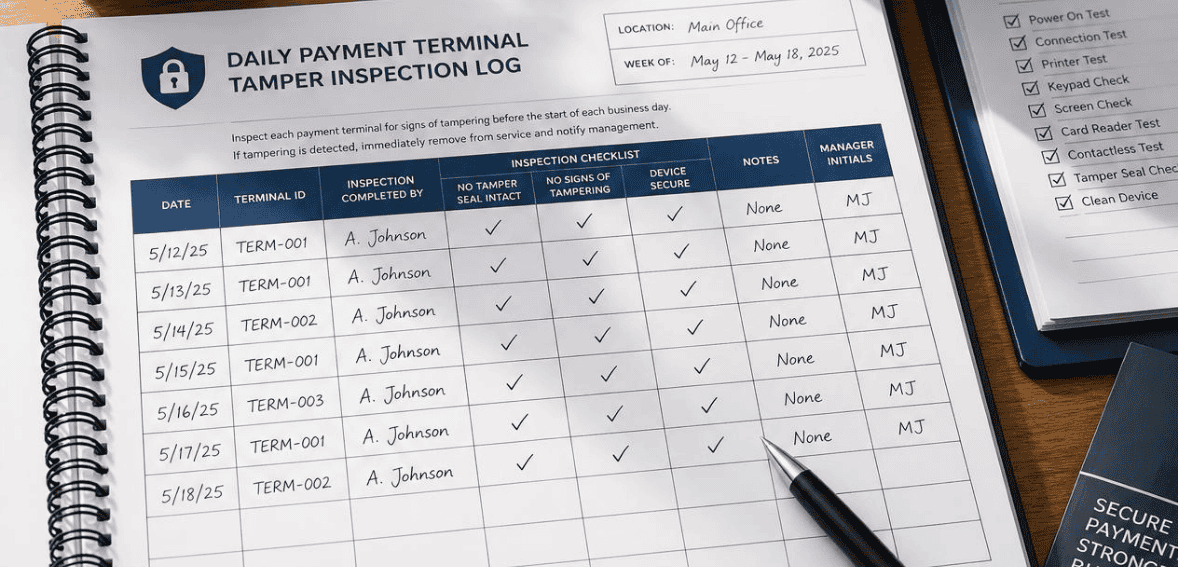
A record of inspections for tampering on a payment terminal is called a payment terminal tamper inspection log. It is an electronic or handwritten log used to record periodic inspections of your card reader for signs of tampering. Entries generally show the date of the inspection, terminal serial/identification number, the inspector’s name, and an inspector’s report. It is similar to a daily health check for devices that interact with and potentially store your customers’ card data.
The log is not merely a bureaucratic exercise. It is proof of an inspection performed. In the unfortunate event your business suffers a data breach and becomes subject to an inquiry from your bank or a card network, this log proves you were looking for tampering. Without this log, you have no proof your terminals were secure this past week, this past month, or this past year.
Why Terminal Hardware Security Deserves Daily Attention
Card-present fraud isn’t going away, even with chip and contactless payments. Criminals continue to target payment terminals. Payment terminals are easy targets because many chip and contactless readers are often unattended. They are easy to access, which lets criminals tap directly into card data.
The FBI estimates card data skimming from ATMs and payment terminals costs financial institutions and consumers over a billion dollars every year. This estimate also includes skimming data from payment terminals used at fuel service stations. This figure also shows why payment terminals must be inspected every day and not only a few times a year.
Tampered payment terminals usually go undetected for several days, even weeks. Tampering with payment terminals is easy, requires little skill, and takes only a few minutes of access. Payment terminal tampering includes inserting a skimming device, attaching a spy camera, and replacing a terminal with a device containing malicious firmware. Daily inspection of terminals prevents these tampering attacks.
PCI DSS Requirements Behind Terminal Tamper Inspections
Most US businesses that accept card payments are contractually required to follow the Payment Card Industry Data Security Standard, known as PCI DSS. Under PCI DSS version 4.0, Requirement 9.5.1 replaced the older Requirement 9.9 and directly addresses point-of-interaction, or POI, devices. This requirement states that businesses must protect card-reading devices from tampering and unauthorized substitution.
This requirement involves three related components. First, a business must maintain an up-to-date inventory of every owned or operated terminal, including the make, model, and serial number. Second, staff must routinely examine terminal devices for evidence of tampering, component removal, and equipment substitution. Third, staff must be trained to identify suspicious behavior concerning equipment and report it to the appropriate authority. When auditors examine a business for PCI compliance, they focus on the existence of inspection logs and whether the frequency of those logs matches the business’s stated procedures.
PCI Security Standards Council
The PCI Security Standards Council has created and published a principles and practices guide for merchants on skimming prevention. PCI SSC does not directly issue fines; instead, its standards and guidelines are embedded in the contracts that merchants sign with acquiring banks and card networks. Although the PCI SSC is not a regulatory body, non-compliance with the terminal security guidelines issued by the Council could result in real financial impact and operational challenges from the banks and card networks.
What to Check During a Daily Tamper Inspection
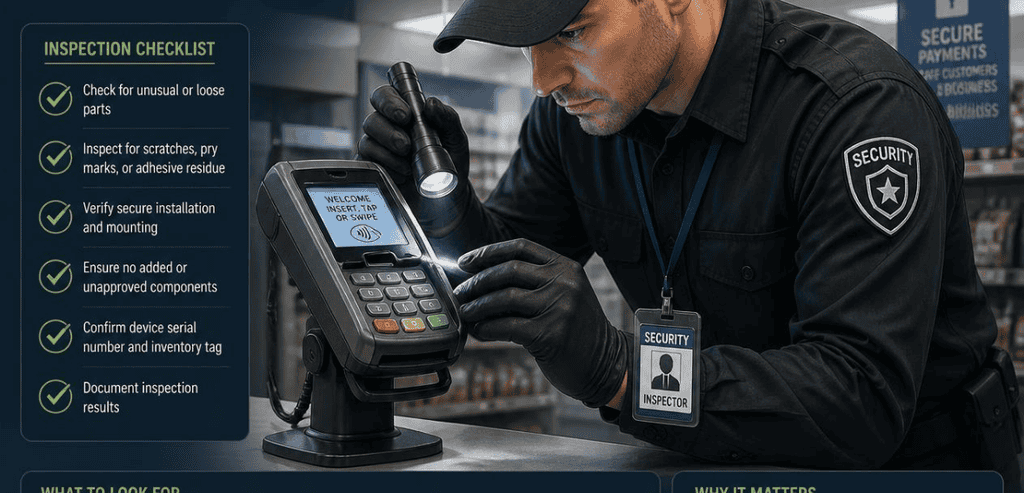
An effective daily inspection of the terminal should cover the entire terminal, not just the card slot. First, check that the terminal’s serial number and location match the records. A dangerous and hard-to-detect method of tampering is swapping devices. Next, conduct a physical inspection of the card reader. Tug on the card slot. Skimmers are generally attached using double-sided tape, so they may pull away from the reader when tugged. Examine the card reader for scratches, residues of glue, tape, and/or mismatched paint. Overlay skimmers may be positioned on top of the card reader with glue.
Examine the card reader and the screen for any unusual reflective surfaces, pinhole cameras, or plastic that was not part of the original unit. Examine the back of the card reader and plastic for loose wires, new attachments, and tape covering an access point. The PCI SSC has guidance surrounding security tape on fuel pump terminals. A torn or missing “void” seal can be an indicator of tampering, and the same check applies to other terminals fitted with security seals. Lastly, when possible, check that the terminal responds normally. A tampered terminal may respond with a new, unfamiliar screen. Each of these inspections is less costly than a potential data breach.
How to Build a Daily Payment Terminal Tamper Inspection Log
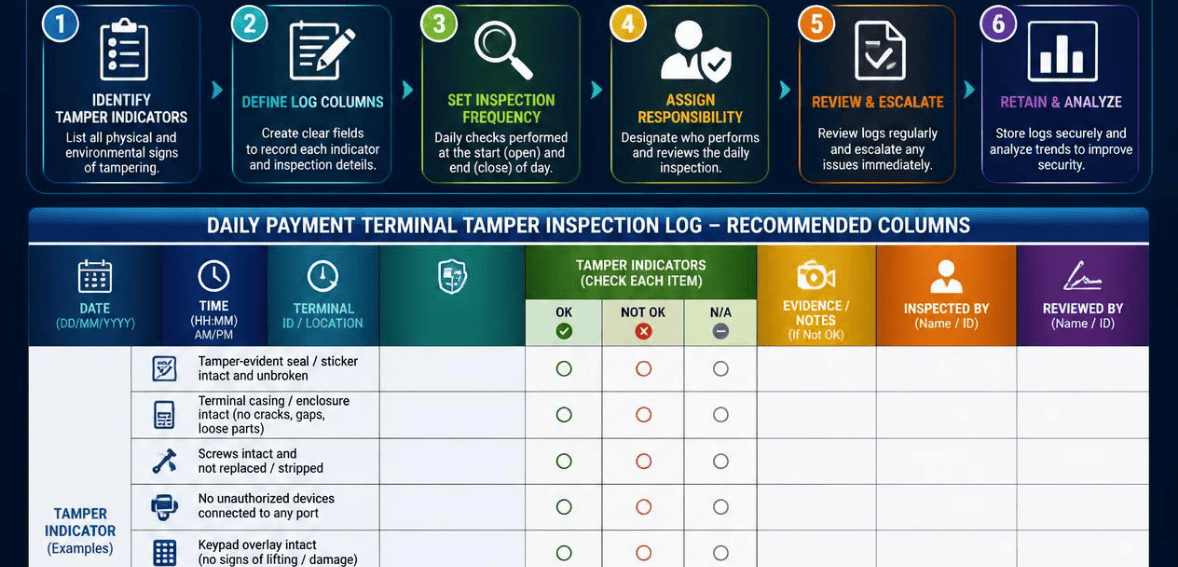
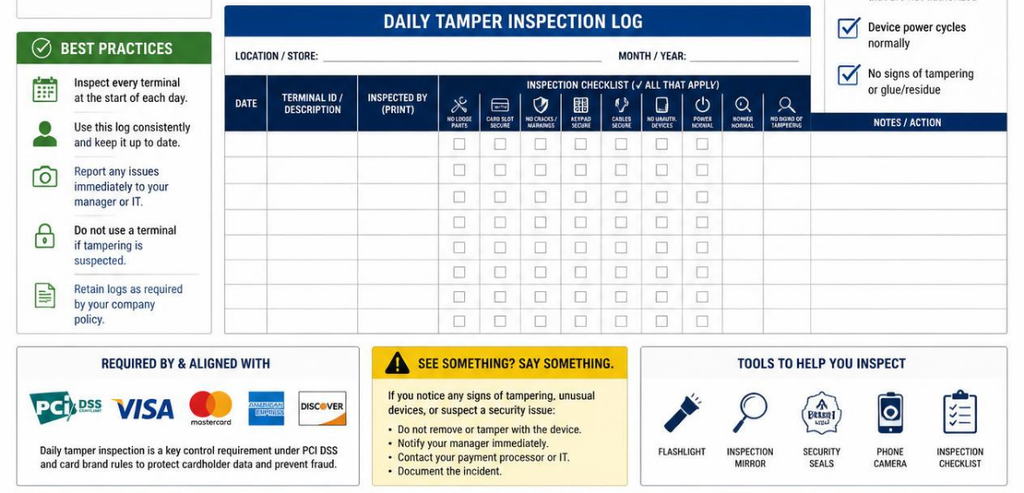
A good log does not need special software. It needs consistency. Many businesses use a simple printed sheet at each register, while others use a shared spreadsheet or a dedicated compliance app. What matters is that every terminal gets checked every day it is used, and every check gets recorded immediately, not from memory at the end of the week.
Key Fields Every Log Should Include
Your tamper inspection log should include the following fields: date and time of inspection, terminal serial number and location, name or initials of the inspector, a concise Yes or No result, and a notes field for anything that was out of the ordinary, even minor issues. This field is more important than most people realize. It’s common for multiple minor discrepancies that happen on multiple days to all add up to a major tamper event in the system.
Merchants who operate under a Terminal Management System (TMS) provided by a third-party vendor should also be sure to confirm in writing which inspection activities are the vendor’s responsibility (and which are the merchant’s responsibility), as PCI SSC guidance explicitly states that the responsibility is shared.
Common Signs of Terminal Hardware Tampering or Skimming
Detection of tampering involves identifying changes in appearance and touch compared to the normal state of the terminal. Financial institutions and federal agencies have cited numerous examples, including keypads with abnormal thickness or angle, card slots that extend further than normal, and color mismatches between the device body and an attached component.
All evidence of tampering, including loose or missing screws, excessive glue (which is often a first sign of tampering), and devices obviously opened and closed repeatedly, should never be met with a “wait and see” approach from the terminal operator; instead, it should be reported immediately, and the terminal should be shut down right away. To identify changes in a terminal, it can be useful to compare it to a reference picture taken when the terminal was first installed, since subtle changes over time can be difficult to remember.
Best Practices for Maintaining an Accurate Inspection Log
Tamper inspection logs are simple. Pick a time, and do it every day. If inspections are done before or after business hours, they are less likely to be skipped due to rush. Inspections should be logged every day, and the completed logs should be saved in an accessible location for twelve months. That’s because PCI compliance reviews and card network audits do not warn you when they request an inspection of your past logs.
It is helpful to photograph every terminal and keep the images with the logs. A photo will help confirm to a new employee or an auditor that no changes have been made. Inspections are more effective when there is some variety in the personnel doing them, since a second set of eyes can catch something that was overlooked. It is all about discipline and having a manager who is willing to consistently maintain these habits.
Training Staff to Spot Tampered Payment Terminals
Log quality depends on the log keeper. PCI DSS Requirement 9.5.1.3 requires employees to be trained to identify suspicious behavior towards payment devices and to recognize maintenance technicians requesting unsupervised access to payment terminals, among other things. Employees must be trained to identify and verify the legitimate reason for the maintenance technician’s presence before allowing access to payment terminals.
Employees must ensure that the maintenance visit is authorized by management, and they must avoid leaving payment terminals unattended in the presence of a suspicious individual. Criminals use this type of social engineering to gain unsupervised access so they can install payment skimming devices. It is one of the more prevalent methods used to obtain physical access in order to carry out payment skimming attacks.
Consequences of Skipping Terminal Tamper Inspections
There are financial risks to ignoring daily inspections. Businesses that experience data breaches from compromised card terminals suffer financial losses in many ways. Card networks impose fines, increase transaction costs, and often require businesses to pay for forensic audits to investigate card data breaches. In extreme cases, card networks prohibit businesses from accepting card payments. The financial injury from a skimming incident may be temporary, but the damage to a business’s reputation can be permanent.
The public does not trust businesses that do not perform daily inspections. The potential costs of breaches, fines, and loss of trust are far greater than the cost of incorporating daily inspections into security routines. Daily inspections take two minutes and can be done by employees who are already on site.
Conclusion
A daily payment terminal tamper inspection log is a small habit with an outsized payoff. It protects your customers’ card data, keeps your business aligned with PCI DSS Requirement 9.5, and gives you documented proof of due diligence if a bank, card network, or auditor ever comes asking.
The process itself does not require expensive tools or specialized staff. It requires a consistent daily routine, a simple log format, and employees who know what tampering actually looks like. Start with the checklist in this guide, build it into your opening procedures, and treat the log as a permanent part of how your business operates, not a seasonal compliance task.
Frequently Asked Questions
How often should a payment terminal tamper inspection actually happen?
PCI DSS requires periodic inspections, but most compliance guidance, including sample logs published by universities and QSA firms, recommends a daily check before business opens, especially for terminals in high-traffic or unattended locations.
Who is responsible for the tamper inspection log if a third-party manages our terminals?
Responsibility can be shared. If your terminals are managed through a Terminal Management System operated by a vendor, PCI SSC guidance recommends confirming in writing exactly which inspection tasks the vendor covers and which remain with your staff.
What should we do immediately if a terminal shows signs of tampering?
Take the terminal out of service right away, avoid touching it further so it can be examined, and report it to your acquiring bank or payment processor and, if fraud is confirmed, to the FTC. Do not attempt to reuse the device until it has been professionally inspected.
Can a digital spreadsheet replace a paper tamper inspection log?
Yes. PCI DSS does not require a specific format. A digital log is acceptable as long as it captures the same details as a paper log and can be produced quickly if your bank or an auditor requests it.